British Columbia Packaging EPR: The Recycle BC Producer Guide
V. Jain · · 4 min read
British Columbia Packaging EPR: The Recycle BC Producer Guide
British Columbia has been running packaging EPR longer than anywhere else in Canada. Recycle BC, the producer responsibility organization for residential packaging and printed paper, has collected supply data from producers since May 2014. If you sell packaged food or beverages in BC, this is the most mature filing you will touch, and the most predictable one. Here is how it works and how to file your report.
What the program covers
The obligation sits under the Recycling Regulation, B.C. Reg. 449/2004. Producers that supply packaging and printed paper (PPP) to BC residents must register with a PRO, report what they supplied, and pay stewardship fees. Recycle BC runs the residential program that almost every food and beverage brand reports through.
In 2023 the province expanded what counts. Alongside classic PPP, BC added single-use items and other packaging-like products, so coffee cup lids, plastic cutlery, and checkout bags sold with your products can fall in scope. If your compliance calendar still says PPP only, it is worth a fresh look at your SKU list.
Are you obligated?
A producer here is generally the brand owner, first importer, or franchisor that puts PPP on the BC market. Our explainer on who counts as an EPR producer goes deeper on the hierarchy across programs. BC carves out small producers generously. You are exempt if you meet any one of these: annual BC revenue under $1 million, less than one tonne of PPP supplied in the year, a single point of retail sale that is not part of a franchise or chain, or registered charity status.
That one-tonne line is low. A mid-size beverage brand moves past it fast. Weigh before you assume you are out.
The May 31 deadline
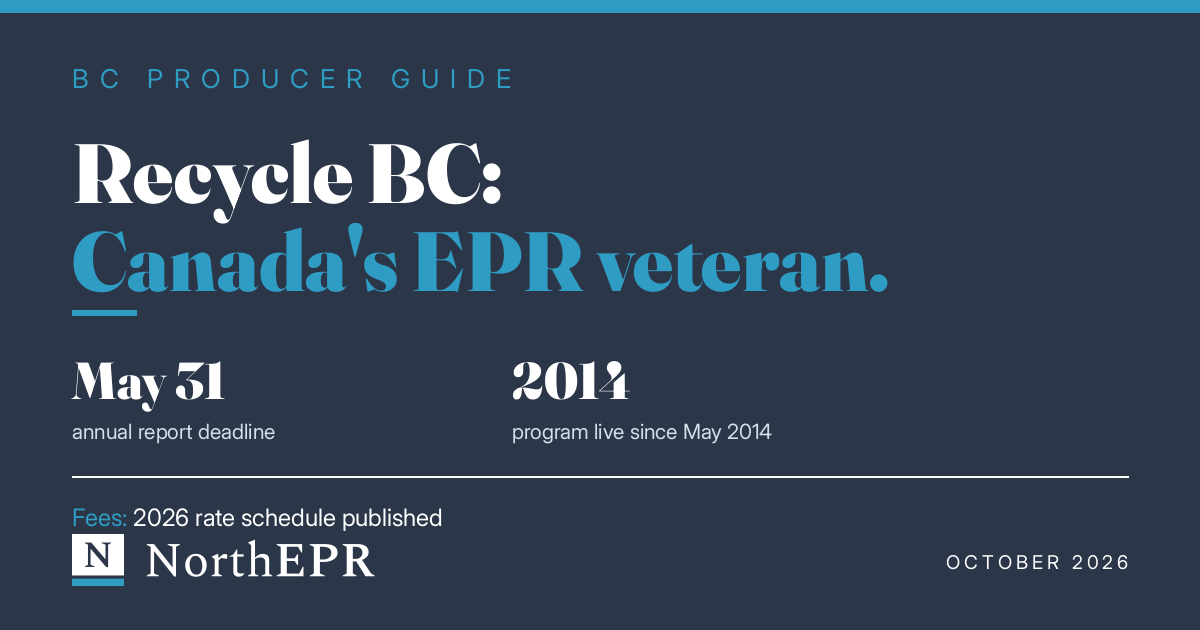
Every year by May 31, obligated producers file their supply data for the previous calendar year through Recycle BC's WeRecycle Portal. The May 31, 2026 filing covered 2025 data. Miss it and you are late to the most established enforcement record in the country. The program publishes its 2026 fee schedule each fall and sets the following year's rates every October, so October is your budgeting month.
How reporting works: detailed vs. flat fee
How you file depends on how much PPP you supply per year:
- Over 15,000 kg: full detailed report, weights by material category against the fee schedule.
- 5,000 to 15,000 kg: simplified report with flat fees (bands of 5,000 to 9,999 and 10,000 to 15,000).
- 1,000 to 4,999 kg: simplified report with low-volume fees (bands of 1,000 to 2,499 and 2,500 to 4,999).
- Under 1,000 kg: exempt.
The simplified tiers exist so smaller producers do not have to weigh every SKU. New stewards who think they qualify for an exemption or a simplified tier are told to contact National Steward Services at 1-888-980-9549 before registering, so the first filing lands in the right bucket.
What the fees look like
Recycle BC publishes a full fee schedule in cents per kilogram. The 2026 rates show how material choice moves the invoice:
- Paper: corrugated 60, boxboard 37, kraft paper 77, gable top cartons 80, aseptic containers 91, paper laminates 77, newsprint 76.
- Plastics: PET bottles 97, PET thermoforms 134, HDPE bottles 47, plastic film 184, plastic laminates 184, rigid polystyrene 151, expanded polystyrene 407, other plastics 101.
- Metals and glass: aluminum food containers 48, other aluminum packaging 70, steel packaging 68, steel aerosols 48, clear and coloured glass 58 each.
Two numbers tell the whole story: corrugated at 60 cents a kilo versus expanded polystyrene at 407. Material choices made in a design meeting show up directly on the EPR invoice. Our guide on how EPR packaging fees are calculated walks through the mechanics.
Voluntary stewardship
If your company is not resident in BC but supplies product into the province from elsewhere in Canada, you can volunteer as a steward for your brands at the one-tonne de minimis, and the retailer obligation falls away. The catch: you file for every brand you supply, and you notify each customer that they are covered by your report.
Your filing checklist
- Confirm producer status and whether an exemption applies.
- Register with Recycle BC if obligated.
- Decide detailed vs. simplified reporting based on your tonnage.
- Build the SKU-level packaging inventory with weights. Our guide on how to weigh packaging for your first EPR report shows how to do this without a lab.
- File through WeRecycle by May 31.
- Budget against the October fee schedule for next year.
The hard part is the data
Most producers do not have a clean, SKU-level packaging inventory sitting around. The weights live across suppliers, spec sheets, and spreadsheets. We built NorthEPR to fix that: software that helps food and beverage producers figure out where they have to report, what they owe, and get their filings ready on time. We are opening 3 free pilot spots for a 2026 packaging-data health check plus first filing support. If BC is on your radar, take a look at the pilot.