Missed an EPR Filing Deadline? Here Is What It Costs in Oregon, California, and Ontario
V. Jain · · 6 min read
Missed an EPR Filing Deadline? Here Is What It Costs in Oregon, California, and Ontario
Extended producer responsibility was supposed to be all carrots for a while. Register, report, pay fees, and nobody gets fined while the programs stand up. That grace period is over. In 2026, the first real enforcement wave landed, and it landed on recognizable brands.
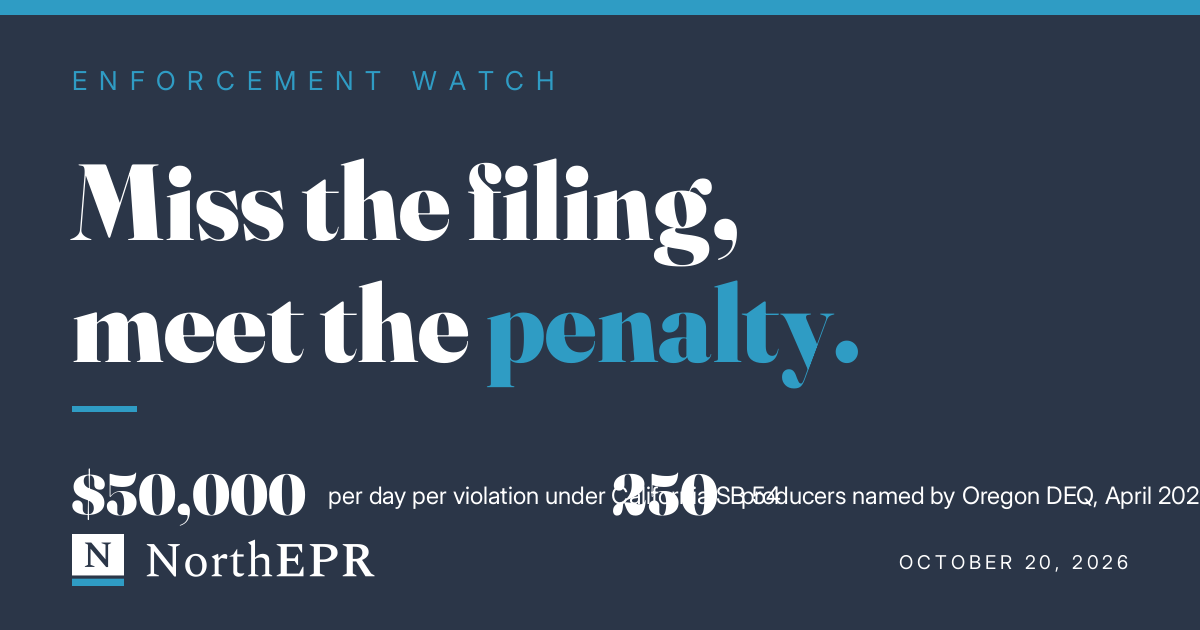
In April 2026, Oregon's Department of Environmental Quality published its first quarterly list of noncompliant producers under the state's packaging EPR law. Two hundred and fifty companies made the list for failing to register, report, or pay fees. The names were not anonymous shell firms. They included Trident Seafoods, Papa John's, Hobby Lobby, and Jack in the Box. Public list, public shaming, and penalties of up to $25,000 per day.
If your compliance calendar has any gaps, this post is for you. Here is what the penalties actually look like across the jurisdictions that are enforcing right now, and what to do if you are already behind.
Oregon: the warning letters, then the public list
Oregon runs packaging EPR through the Recycling Modernization Act, with the Circular Action Alliance (CAA) as the producer responsibility organization. The enforcement path is spelled out, and regulators followed it to the letter this spring.
First, CAA contacts the producer and gives 90 days to come into compliance. Then DEQ issues a formal warning letter with a 30-day correction window. The March 5, 2026 warning letters started that clock for hundreds of companies. Those still out of compliance when the window closed appeared on the April 9 public list on CAA's website.
The exposure is real: civil penalties of up to $25,000 per day per violation, and the Oregon Department of Justice can ask a court to prohibit a noncompliant producer from selling covered products in the state. That last part turns a compliance problem into a revenue problem overnight.
One caveat worth knowing: a federal judge granted a preliminary injunction in February 2026 pausing enforcement against members of the National Association of Wholesaler-Distributors while a constitutional challenge proceeds. An April 1 court order clarified that the pause applies only to companies that were NAW members as of February 6, 2026. Everyone else is still fully subject to the law, and the trial is set for July 13, 2026.
Our Oregon producer guide walks through who is obligated and how to file.
California: the steepest fines in North America
California's SB 54 carries the heaviest penalties of any North American packaging EPR law. CalRecycle can impose administrative civil penalties of up to $50,000 per day, per producer, per violation for failing to register, report, or pay fees. Small producers get a reduced cap of $25,000 per day, but that is still a five-figure daily rate.
Penalties do not start accruing instantly. A producer gets 30 calendar days after being notified of a violation before the meter starts. For a first offense that CalRecycle does not consider egregious, the department is directed to consider capping penalties at $25,000 per day.
The reporting-specific penalties deserve their own line. Refusing or failing to submit required information carries $500 to $5,000 per violation, with each day counted separately. Filing a false report, or obstructing an inspection, jumps to $500 to $10,000 per violation per day. And each product that uses non-compliant covered material counts as a separate violation, so the numbers compound fast.
The timeline matters here. Producers had to register by June 1, 2026 and file baseline supply data. Fees begin in January 2027. If you sold packaged products in California this year and never registered, you are not early. You are already late.
See our California SB 54 guide for the full compliance picture.
Colorado: daily penalties that escalate until you fix it
Colorado's enforcement schedule starts at $5,000 per violation on the first day, plus $1,500 per day for each day the violation continues until it is cured. The structure is designed to make delaying compliance the expensive option and fixing it the cheap one. Colorado's 2026 dues were already invoiced this year, so the state knows exactly who has not paid.
Ontario: fines that scale to corporate size
Ontario has the most mature enforcement record in Canada, and the numbers are larger than most producers expect. Non-compliance with the Resource Recovery and Circular Economy Act can result in fines of C$250,000 per day for a first offence and C$500,000 per day for subsequent offences. Officers and directors who authorize or fail to prevent the offence face personal fines of C$50,000 per day for a first offence and C$100,000 per day after that.
The Resource Productivity and Recovery Authority (RPRA) has a separate tool: administrative monetary penalties, which do not require a court case. To date RPRA has issued more than 20 compliance orders and six AMPs across its EPR regimes, ranging from C$75,000 to C$1 million, averaging around C$545,000. And the province has proposed removing the $1 million cap entirely, on the theory that a penalty that costs less than compliance is just a pricing option.
Our Ontario Blue Box filing guide covers the reporting side.
The pattern across every jurisdiction
Step back and the enforcement playbook is the same everywhere:
- The PRO tries to bring you in voluntarily.
- The regulator sends a formal notice with a correction window, usually 30 days.
- Then come daily penalties, public naming, or sale restrictions.
Nobody wants to fine you on day one. The daily rates exist because a flat one-time fine would be cheaper than complying, and regulators learned that lesson long ago. The compounding daily structure is what makes a missed deadline a board-level problem instead of a parking ticket.
What to do if you already missed a deadline
The consistent advice from compliance counsel is simple: register late rather than never. Every program treats voluntary disclosure better than being caught. PROs have onboarding processes for late joiners, and regulators routinely reduce penalties for producers who come forward on their own.
Here is the practical sequence:
- Figure out where you are obligated. Map every state and province where your products are sold and check the producer definition in each one. Our explainer on who counts as an EPR producer breaks down the hierarchy.
- Register now. Join the PRO (CAA for most US states, Circular Materials or the program PRO in Canada) or register directly with the regulator where that is an option.
- Reconstruct your data. Each missed reporting period means another quarter of packaging data to rebuild: SKU by SKU, material by material, weights by jurisdiction. Our walkthrough of how to weigh packaging for your first EPR report shows the method.
- Talk to the regulator before they talk to you. A voluntary filing with a good-faith correction lands very differently than the same filing after a warning letter.
The longer you wait, the worse the math gets. Every quarter adds another reporting period to reconstruct, and the daily penalties only accrue while you are out of compliance.
The cheapest penalty is the data work you start today
Enforcement is no longer theoretical. Oregon has published names. California's registration deadline passed. Colorado invoiced its 2026 dues. Ontario is proposing to remove the cap on its penalties. The jurisdictions with fines on paper are turning them into fines on invoices.
We built NorthEPR for this exact problem: software that helps food and beverage producers figure out where they have to report their packaging, what they owe, and get their filings ready on time, across Canada and the US. We are opening 3 free pilot spots right now for a 2026 packaging-data health check plus first filing support. If any of these deadlines caught you off guard, take a look at the pilot and we will run the numbers with you.