How to File Your Ontario Blue Box EPR Report
V. Jain · · 4 min read
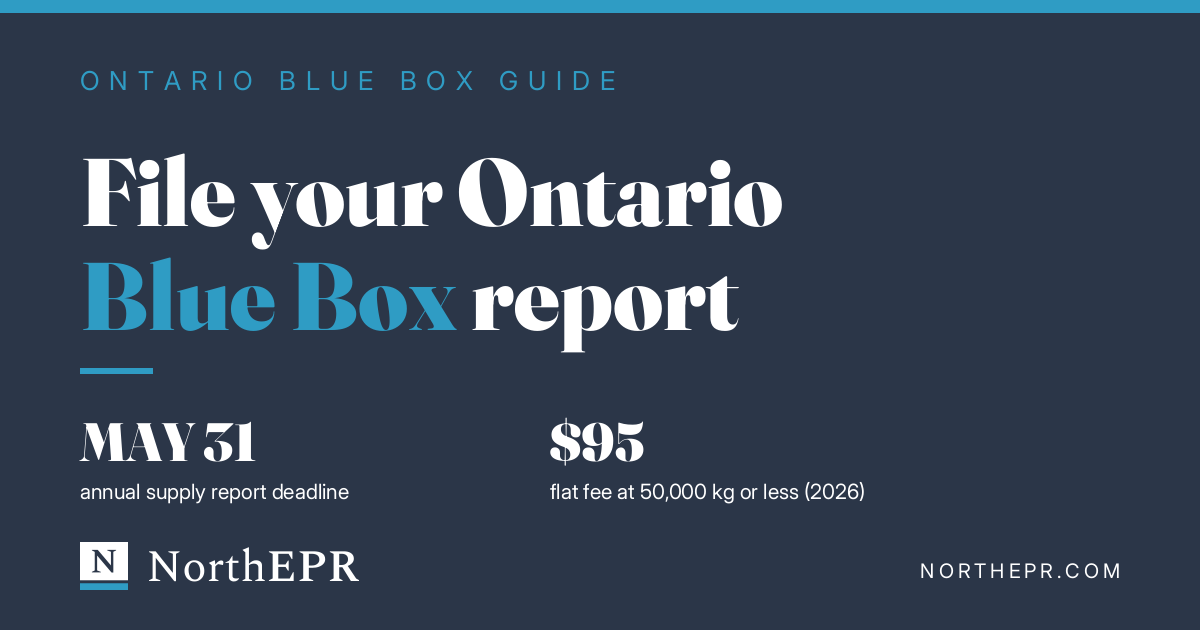
If you sell packaged food or beverages in Ontario, one date matters more than any other: May 31. That is the day Ontario producers file their annual Blue Box supply report with the Resource Productivity and Recovery Authority, the province's EPR regulator. The next report, due May 31, 2027, covers everything you supplied in 2026.
And the math behind that report just got final. RPRA posted its finalized 2027 program fees on October 1, 2026, so producers can now model next year's cost instead of guessing. Here is how the filing actually works, step by step.
Step 1: Confirm you are a producer
RPRA's test is simple on paper. You are a Blue Box producer if you supply Blue Box material, meaning packaging, paper products, or packaging-like products made of paper, glass, metal, or plastic, to consumers in Ontario. A consumer here means someone using the product and its packaging for personal, family, or household purposes, so business-to-business packaging generally sits outside this program.
The obligated party is usually the brand owner: the company whose name is on the package. Franchisors and marketplace facilitators can also be on the hook. New producers have to register with RPRA within 30 days of first supplying obligated material in Ontario, so if you just started selling into the province, the clock may already be running.
If you are new to the whole framework, our complete guide to packaging EPR walks through how producer responsibility works across all 16 jurisdictions we track.
Step 2: Register in the RPRA Registry
Everything in Ontario runs through RPRA's online registry: registration, reporting, and fee payment. Create your account, enter your business details, and confirm which materials and brands you supply. If you registered in a previous year, log in and check that your details, brands, and contacts are still current before you touch the report.
Step 3: Build your packaging inventory
This is where most producers spend the real time. The report asks for weights, not dollars, broken across seven material categories:
- Beverage container
- Glass
- Flexible plastic
- Rigid plastic
- Metal
- Paper
- Certified compostable products and packaging
For every SKU you sold into Ontario, you need each packaging component, its material, and its weight: the bottle, the cap, the label, the box, the shipper that reaches the consumer. The report also asks you to confirm whether your gross annual revenue in Ontario is above or below $2 million, to list the brands that make up your supply data, and to claim any permitted deductions. Be careful with deductions: the regulation's rules on what can be subtracted are strict, so verify before you deduct anything.
Step 4: File the annual supply report by May 31
The report covers the previous calendar year and is submitted through the registry. Your numbers do double duty. They set your RPRA program fee, and they set your management requirement: the amount of Blue Box material you are responsible for recovering in the following year. That is why rough estimates are expensive. A sloppy inventory inflates both your fee and your recovery target.
Treat May 31 as a hard deadline. RPRA is explicit that failing to submit on time, or submitting false or misleading reports, can lead to compliance orders and administrative penalties. And since the old Stewardship Ontario program wound up on December 31, 2025, the registry is now the only door. There is no legacy program left to fall back on.
Step 5: Pay the program fee
You pay the annual fee when you submit the supply report. For 2026, RPRA's schedule was a flat $95 for producers supplying 50,000 kg or less of Blue Box material, and $0.0097 per kg above that threshold, plus HST. The finalized 2027 fees, posted October 1, 2026 and effective January 1, 2027, are on RPRA's website, so pull the current schedule before you model next year's cost.
The mistakes we see most often
Estimating instead of weighing. Guesses compound across a full SKU list. One wrong component weight, repeated across thousands of units, becomes a five-figure fee error.
Forgetting components. The cap, the label, the neck ring, the shipper box that reaches the consumer: all of it is reportable material.
Leaving the brand list for last. The registry wants the brands behind your supply data. Compiling that in the final week is miserable.
Starting in May. The report is due May 31, but the inventory behind it should be built from your 2026 records now, while the year is still fresh and your suppliers still answer emails.
Get the filing right the first time
Ontario's Blue Box program is Canada's largest packaging EPR regime, and it is fully producer-run now. The rules are public, the deadlines are fixed, and the fees are finalized. The only variable left is your data.
We built NorthEPR to take this off producers' plates: software that helps food and beverage producers figure out where they have to report, what they owe, and get their filings ready on time. We are opening 3 free pilot spots for a 2026 packaging-data health check plus first filing support. If Ontario is one of your markets, take a look at the pilot.