New Brunswick Packaging EPR: The Producer Guide for 2026
V. Jain · · 4 min read
New Brunswick Packaging EPR: The Producer Guide for 2026
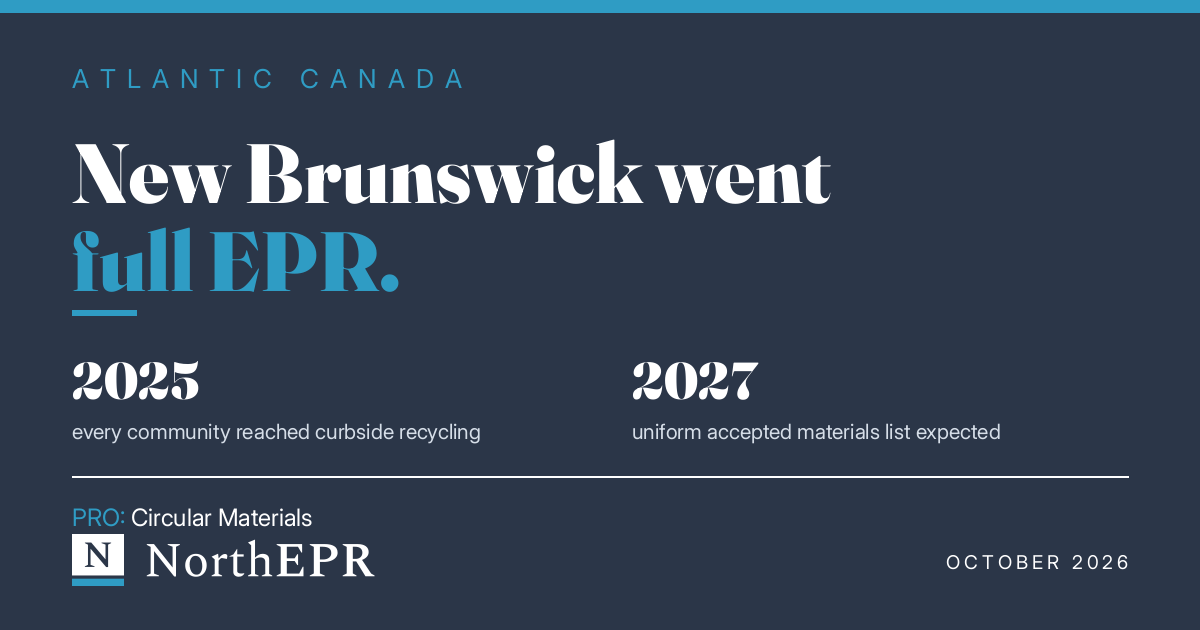
New Brunswick is deep in an EPR transition, and for Atlantic producers it is the market you cannot treat as an afterthought. The province's packaging and paper EPR program runs on the amended Designated Materials Regulation, overseen by Recycle NB, with Circular Materials as the province's designated producer responsibility organization. In 2025 the program hit a real milestone: every community in the province gained access to curbside recycling. Now the focus is on expanding collection to schools and multi-family dwellings, and a uniform accepted materials list is expected in 2027.
If you sell packaged food or beverages into New Brunswick, here is what the program covers, who has to comply, and what to do about it right now.
What the program covers
New Brunswick's framework covers packaging and paper products supplied into the province. The province started with its original Designated Materials Regulation (2008-54) and later amended it to build the EPR system that is operating today. Recycle NB regulates the program, and Circular Materials, which also runs the systems in Ontario, Nova Scotia, and several other provinces, administers it as the PRO.
This matters because New Brunswick and Nova Scotia now share one PRO. If you sell into both provinces, your registration relationship and your packaging data source are the same. Report once, allocate by province. For the Nova Scotia side, see our Nova Scotia 2026 Divert NS invoice guide.
Who has to comply
The obligated party is the producer. Start with the brand owner: if your brand is on the package sold into New Brunswick, the obligation is probably yours. The hierarchy also catches importers, marketplace facilitators, and franchisors where they are the ones putting designated material into the province. We walk through the producer hierarchy in detail in our explainer on who counts as an EPR producer.
There are small-producer carve-outs in the regulation. Industry summaries of the program put them at roughly under $2 million in gross annual income in New Brunswick, under one tonne of designated material supplied per year, and registered charitable organizations. Those thresholds are narrow, and a mid-size food or beverage brand shipping across Atlantic Canada can cross one tonne of packaging faster than it sounds. If you are anywhere near those lines, measure first and confirm your status with Circular Materials or Recycle NB before assuming you are exempt.
The timeline as it stands in October 2026
The program's building blocks are already in place. The amended regulation created the current framework, producers moved onto the new registration system in 2025 and 2026, and 2025 was the year curbside recycling reached every community in the province.
What is still ahead:
- November 1, 2026: New phases of collection service come online for schools and multi-family dwellings, expanding where the system reaches.
- 2027: A uniform accepted materials list is expected, which will standardize what counts as recyclable across the province. This list directly affects which of your packaging materials the program covers, so it is the document to watch.
- Beyond: Like the other Atlantic and Canadian programs, fees flow through the PRO and rise as the system expands. Costs track real system spending, so your share depends on your materials, your weights, and how much of your packaging is actually recyclable.
What your fees depend on
Circular Materials sets producer fees from your reported packaging data, usually weight by weight across its material categories, with eco-modulation that rewards recyclable packaging and penalizes formats that contaminate or cannot be sorted. Our explainer on how EPR packaging fees are calculated shows how these formulas work across programs.
Two things about New Brunswick's design shape your bill. The program is expanding its collection footprint, which grows the system your fees fund. And the uniform accepted materials list in 2027 will clarify exactly which materials are in and out.
What producers should do now
- Confirm your registration with Circular Materials. If you sell into New Brunswick, you should be registered as a producer with the PRO. If you are already registered for Ontario or Nova Scotia, check that New Brunswick is on your account.
- Build your SKU-level packaging inventory. Every component, every material, every weight for everything you sold into New Brunswick. Your fees come from this data, and so does your audit defense. We walked through the method in our guide to weighing packaging for a first EPR report.
- Watch the uniform accepted materials list. When it lands in 2027, compare every one of your SKUs against it. Materials that fall outside the accepted list are where fee risk concentrates.
- Treat the Atlantic provinces as one system. Your New Brunswick, Nova Scotia, and Ontario data are the same SKU-level weights allocated by jurisdiction. One source of truth beats three spreadsheets.
The bottom line
New Brunswick stopped being a wait-and-see market. The regulation is in force, the PRO is operating, curbside reached every community in 2025, and the 2027 materials list will sharpen exactly what your packaging costs you.
If you are new to the whole framework, start with our complete guide to packaging EPR and go from there.
We built NorthEPR to make this boring: one engine that maps where you are obligated across Canada and the US, calculates what you owe, and gets your filings ready on time. We are opening 3 free pilot spots right now for a 2026 packaging-data health check plus first filing support. If New Brunswick is one of your markets, grab a free pilot check on your 2026 packaging data and we will run the numbers with you.