Why Your Pouch Costs More Than Your Bottle: How Per-Material EPR Fees Work
V. Jain · · 5 min read
Why Your Pouch Costs More Than Your Bottle: How Per-Material EPR Fees Work
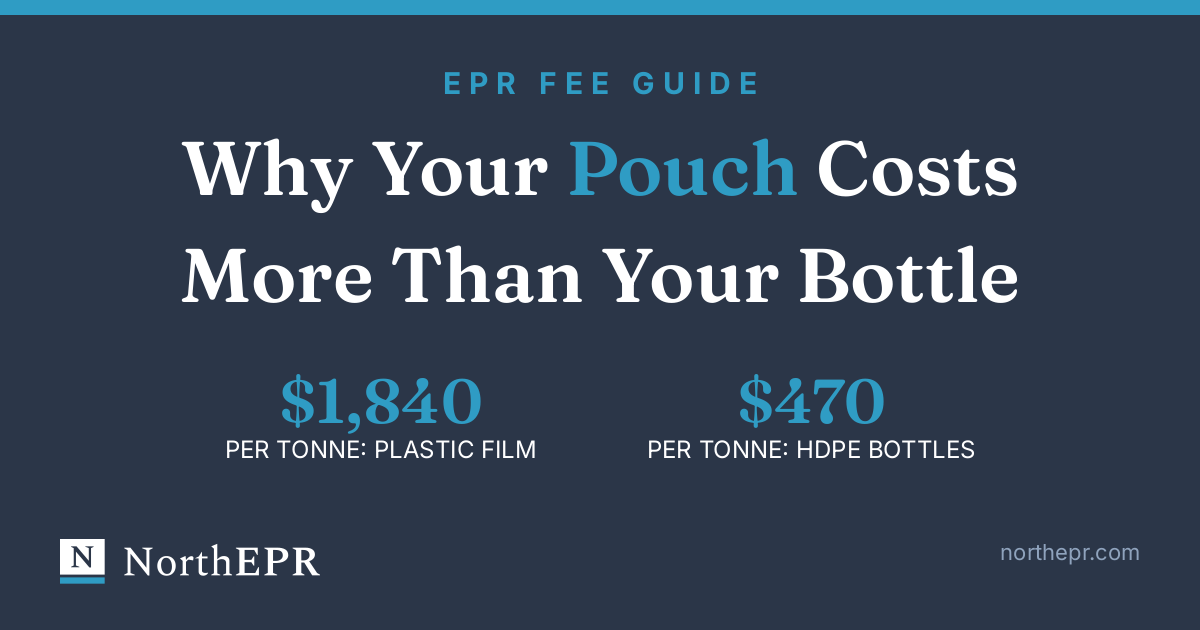
Take two tonnes of packaging. Same weight, same truck, same warehouse. In British Columbia in 2026, one tonne could cost you $470 in EPR fees and the other $1,840. The difference is not the weight. It is what the package is made of.
This is the thing most food and beverage producers miss when they first look at an EPR program. Fees are not charged per SKU or per unit sold. Every producer responsibility organization publishes a fee schedule that breaks packaging into material categories, assigns each category a rate in cents per kilogram, and bills you on the weight you reported in each one. Your total is weight times rate, category by category, added up. Get the categories wrong and your bill is wrong.
How a fee schedule actually works
Here is the anatomy of a real one. Recycle BC publishes its fee schedule every year with one rate per material category. For 2026, a few of the categories that matter most to food and beverage brands:
- Corrugated cardboard: 60 cents/kg
- Boxboard: 37 cents/kg
- Kraft paper: 77 cents/kg
- PET bottles: 97 cents/kg
- HDPE bottles: 47 cents/kg
- Plastic film: 184 cents/kg
- Plastic laminates: 184 cents/kg
- Aseptic containers: 91 cents/kg
- Gable top cartons: 80 cents/kg
- Aluminum food containers: 48 cents/kg
- Clear glass: 58 cents/kg
- Expanded polystyrene: 407 cents/kg
The math is weight times rate. A brand supplying 2 tonnes of HDPE bottles into BC pays 2,000 x $0.47 = $940. The same 2 tonnes as plastic film: 2,000 x $1.84 = $3,680. Same material family, a fee gap of nearly four times, because each category reflects how that material actually behaves in the recycling system.
If you have never weighed your packaging by category, our walkthrough of how to weigh packaging for your first EPR report shows how to build the data from scratch.
Why some materials cost so much more
Fee rates are not arbitrary. A PRO has to cover the real net cost of collecting, sorting, and processing each material, minus whatever revenue it can get from selling the recovered material. Three things drive the spread:
-
Collection and sorting cost. Lightweight, awkward materials cost more to handle. Film wraps around sorting screens. Multi-layer laminates cannot be separated into their layers at commercial scale, so they go through an expensive path or nowhere at all.
-
End markets. A clean bale of PET bottles has buyers competing for it. A bale of mixed flexible plastic mostly does not, so the cost of managing it lands on the producers who put it there.
-
Recyclability at scale. Expanded polystyrene (407 cents/kg in BC, the highest rate on the schedule) is bulky, crumbles in handling, and has thin end markets. Aluminum food containers (48 cents/kg) are among the cheapest because aluminum recycles efficiently and holds its value.
So when a pouch costs several times more than a bottle of the same weight, it is not a punishment for using plastic. It is the system pricing in what that material actually costs to manage after the consumer drops it in the bin. If you want the theory behind the whole model, our explainer on how EPR packaging fees are calculated covers the cost base behind every schedule.
Rates move every year, so last year's math expires
Fee schedules are republished annually, and the changes are not rounding errors. In Recycle BC's 2025 to 2026 update, kraft paper jumped 45.3% (53 to 77 cents/kg), expanded polystyrene rose 31.3% (310 to 407), plastic film and laminates rose 26% (146 to 184), and rigid polystyrene rose 20.8%. Going the other way, aluminum food containers fell 18.6% (59 to 48) and PET bottles ticked down 1%.
The lesson is simple: never budget next year's fees with this year's rates. When the new schedule lands, usually late in the calendar year, re-run your numbers before you lock in packaging budgets.
Where this is heading: fees that reward better design
Right now, North American schedules differentiate by material category. The next step, already visible elsewhere, is fees that also differentiate by recyclability within a material. The UK's Year 2 packaging EPR fees apply a green, amber, and red recyclability rating: red-rated plastic pays about 130 pounds per tonne more than green-rated plastic, and the red multiplier is scheduled to rise to 2.0 times the base rate by 2028. France's Citeo tariff runs a similar system of eco-modulation bonuses and penalties.
For North American producers this is a signal, not yet a line item on an invoice. Packaging choices that look cheap today can become the expensive line on a future fee schedule. If you are redesigning packaging anyway, choosing a widely recyclable format is a hedge against the next schedule, not just a sustainability story.
How to estimate your own bill
- Split your packaging inventory by the PRO's material categories, not by your internal SKUs. You need weights in kilograms for each category the schedule lists.
- Multiply each category by the current published rate. Use the schedule for the year and jurisdiction you are reporting in; every program publishes its own.
- Add a buffer. Rates change every year and misclassification is common. A 10 to 15 percent buffer is cheap insurance.
- Read the category definitions carefully. "Paper laminates," "plastic laminates," and "plastic film" are separate lines with separate rates. A stand-up pouch is a plastic laminate at 184 cents/kg in BC, not generic "plastic." Classification is where most billing surprises come from.
This is the part of EPR that a spreadsheet cannot do well, because the categories and rates shift every year and differ in every jurisdiction. We built NorthEPR so food and beverage producers can see where they have to report, what they owe by material and jurisdiction, and get their filings ready on time. We are opening 3 free pilot spots for a 2026 packaging-data health check plus first filing support. Take a look at the pilot.