Quebec Packaging EPR: What Producers Need to Know for 2026
V. Jain · · 4 min read
If you sell packaged food or beverages in Quebec, the province already put you in charge of your own packaging waste. Since January 1, 2025, Quebec's modernized curbside recycling system runs under full producer responsibility, managed by Éco Entreprises Québec (ÉEQ). That was nearly two years ago, which means the system is no longer new. It has a published track record, a finalized 2026 fee schedule, and real expectations attached to it.
Here is what Quebec's program looks like for a producer right now, and what you need to do about it.
Who is obligated in Quebec
The obligated party is the brand owner of containers, packaging, and printed matter sold to consumers in Quebec. If your name is on the package and you sell into the province, you are in the system. ÉEQ administers the program, collects producer reports and fees, and now manages the entire curbside collection network.
If you are new to producer responsibility in general, our complete guide to packaging EPR explains how the model works across all 16 jurisdictions we track.
The 2025 results are in, and producers are graded on them
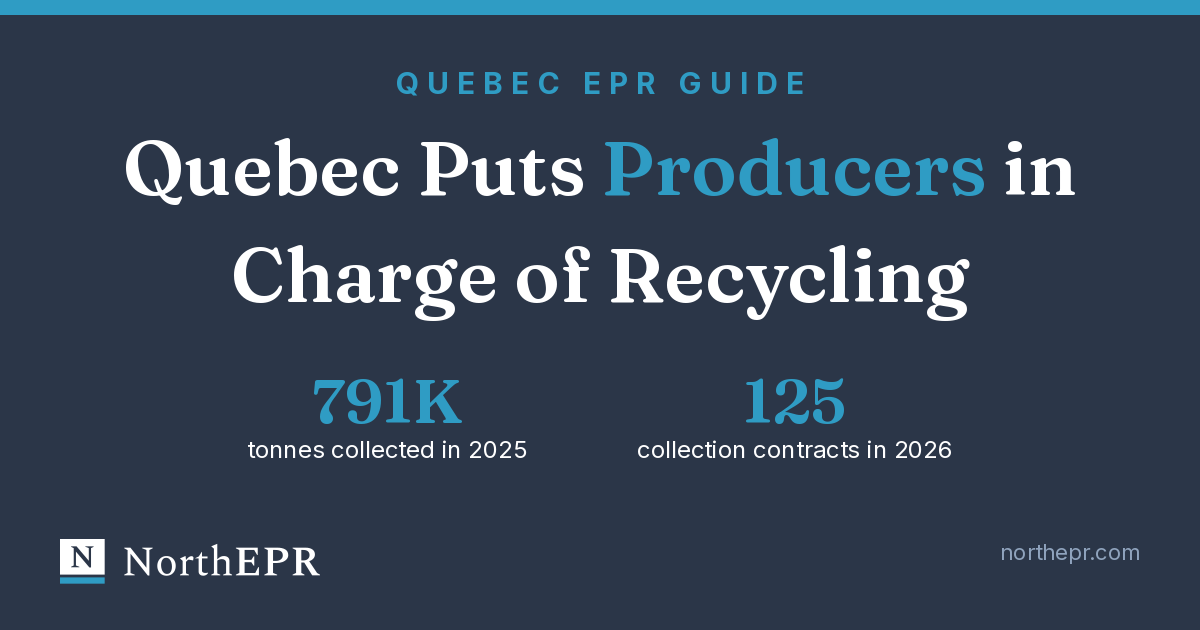
Quebec just completed its first full year under the modernized system, and ÉEQ published the numbers. The system collected 791,000 tonnes of material in 2025, sent 607,000 tonnes for recycling, and achieved an 87 percent residential collection rate. Contamination dropped from 14 to 13 percent. About 63 percent of the recycled material was processed inside Quebec.
This matters for producers because the collection rate is now measured against tonnes reported by producers themselves. Your reported numbers are not just the basis for your fee. They are the benchmark the whole system is scored on, which is why accurate reporting keeps getting more important every year.
The system also consolidated operations fast. Quebec went from 562 distinct municipal collection contracts in 2024 to 125 contracts as of January 1, 2026. ÉEQ is also taking over the sale of recovered materials province wide. The program is behaving like a real producer-run system now, not a patchwork of municipal contracts.
How the 2026 fees work, including eco-modulation
Quebec uses a weight-based tariff with fixed rates for smaller producers. For 2026, the fixed rates run from $1,430 for producers putting 1 to 2.5 tonnes on the market, up to $10,240 for the 10 to 15 tonne band. Larger producers pay variable per-material rates.
The part to watch is eco-modulation. Quebec is actively penalizing hard-to-recycle packaging in the fee schedule. Fees for PVC and PLA packaging roughly doubled, and the design of the schedule pushes producers toward single-material packaging, less over-packaging, and lighter containers. Every packaging decision you make now shows up in your next invoice with a multiplier attached.
This is the practical takeaway: if you have not reviewed your packaging mix against Quebec's eco-modulated rates, do it before your next report. Swapping one problematic material can move your fee more than trimming weight across the board.
One accepted-materials list for the whole province
One of the best parts of the modernization is simplicity on the consumer side. The list of recyclable materials accepted in the bin, covering containers, packaging, and printed matter, is now the same across Quebec. That reduces the contamination and confusion that used to vary by municipality, which feeds directly into the recycling results producers pay for.
What to do now
- Confirm your registration with ÉEQ. If you sell packaged products to Quebec consumers, you should be registered and reporting. New sellers into the province should not wait for the next cycle.
- Build a clean packaging inventory. Every SKU, every component, every material and weight. Quebec grades the system against what producers report, so sloppy data hurts you twice.
- Pull the current 2026 tariff before you model. Use ÉEQ's published schedule for your actual product mix, not a national average.
- Audit your materials against eco-modulation. Identify any PVC, PLA, or other hard-to-recycle components and price the penalty against the cost of switching.
- Watch the ICI share. About 20 percent of material collected in Quebec in 2025 came from institutions, businesses, and industries. If your products reach that channel, make sure your reporting reflects it.
Quebec is the template, not the exception
Quebec went through the painful part first: full producer responsibility, a consolidated collection network, and fees that reward good design. The other provinces are moving in the same direction. Getting your Quebec reporting right gives you the inventory, the material data, and the process you will need everywhere else.
We built NorthEPR to make this manageable: software that helps food and beverage producers figure out where they have to report, what they owe, and get their filings ready on time. We are opening 3 free pilot spots for a 2026 packaging-data health check plus first filing support. If Quebec is one of your markets, take a look at the pilot.