What Does EPR Compliance Software Cost?
V. Jain · · 5 min read
In short: EPR compliance software is usually priced as an annual subscription, and the headline number only means something once you know what it covers: how many jurisdictions, how many SKUs, and whether onboarding and program fees are included. The common models are flat annual tiers, per jurisdiction pricing, and per SKU or volume pricing, often with a one time setup fee on top. Regulator and PRO fees are separate in every model we have seen, because you pay those directly to each program. Compare quotes on the same scope, not on the headline price alone.
Why software pricing looks confusing
Ask three vendors what EPR software costs and you will get three numbers that do not line up, and all three can be honest: one covers a single province, another covers every jurisdiction you sell into, a third looks cheap until setup and extra jurisdiction fees land. The confusion is scope. EPR work scales with where you sell and how many distinct packages you sell there.
Before you compare anything, write down your scope: where you sell, how many SKUs you have, and whether you sell private label or seasonal lines. Then ask each vendor to price that scope, in writing, for a full year.
The four pricing models you will meet
Flat annual tiers. You pay one annual subscription for a band of coverage, for example one jurisdiction, several jurisdictions, or all jurisdictions a vendor covers. This is the easiest model to budget, because the number does not move when you add a SKU. Ask what adding one more jurisdiction costs, and whether the tier covers filing preparation for every program in the band.
Per jurisdiction pricing. You pay a base fee plus a set amount for each additional jurisdiction. This suits a producer selling into two or three places, and gets expensive fast nationally or cross border. Ask what counts as a jurisdiction in the quote.
Per SKU or per volume pricing. You pay based on catalogue size or the weight of packaging you report. This tracks with the work involved, since more SKUs mean more weights and material mappings. The risk is a surprise at renewal if your catalogue grows. Ask how SKUs are counted: active SKUs only, or every SKU sold in the reporting year, including discontinued lines?
One time setup, plus subscription. Most tools charge a setup fee in year one, on top of the subscription, covering your SKU list, packaging weights, and material mappings. A setup fee is not a red flag on its own. An unscoped one is: ask what is included, what happens if supplier data arrives late, and whether year two carries a refresh fee.
What is almost never included
Two costs sit outside software subscriptions as a rule. First, regulator and PRO fees: the fees each program charges on the packaging you report, paid directly to the program. Software helps you calculate them, but the program fee itself is not a software cost, and it varies with your weights and each fee schedule. Our guide to reading a fee schedule shows how those fees are built.
Second, your own internal time in year one. Gathering weights, chasing suppliers, and reviewing first drafts takes staff time no matter which tool you buy, and no tool reduces year one to zero.
What NorthEPR charges, plainly
We publish our prices so you can compare them without a sales call. Our annual subscriptions, in Canadian dollars, are listed on our pricing page:
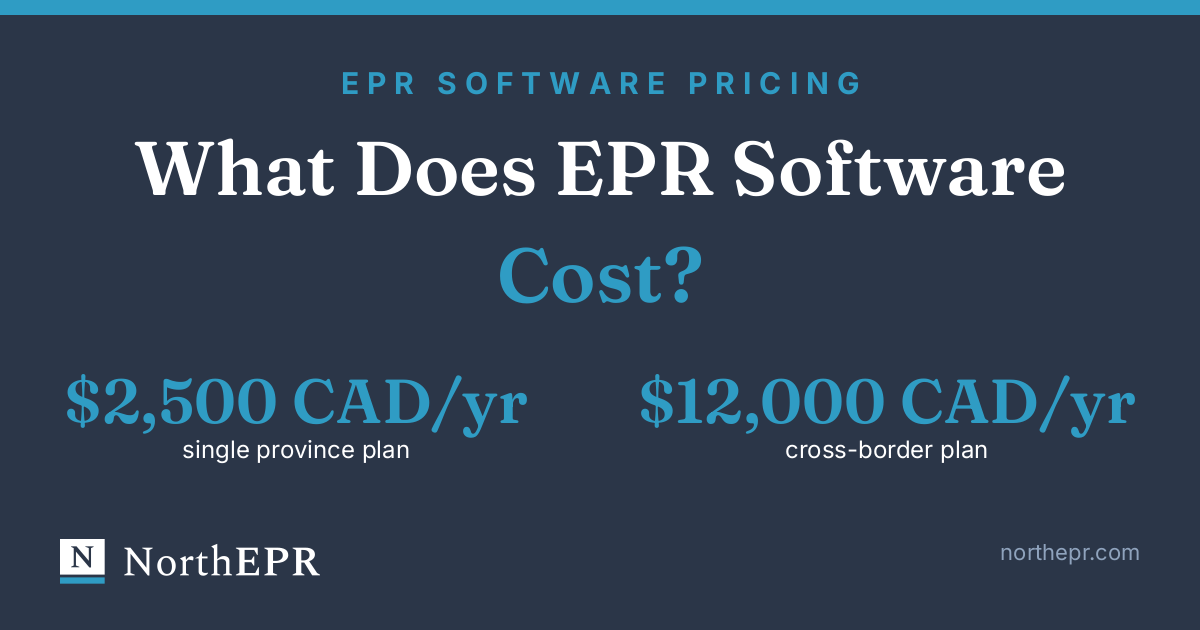
- Single province: $2,500 CAD per year, for one jurisdiction, covering obligation checks, fee calculation, filing preparation, and an audit trail.
- Canada multi: $7,500 CAD per year, for up to 7 jurisdictions including the federal registry.
- Cross border: $12,000 CAD per year, for all Canadian and US jurisdictions we cover.
On top of the subscription, there is a one time onboarding and data setup fee, typically $500 to $2,500, scoped to your catalogue and agreed with you before paid onboarding starts. Regulator and PRO fees are separate and paid by you directly to each program. We do not take a cut of your program fees, and we do not file or pay on your behalf: you review each prepared draft and file it yourself.
See how our coverage compares and every filing deadline in one calendar before you decide which tier fits.
How to compare quotes fairly
Use these five questions for every vendor:
- How many jurisdictions does this price cover, and what does one more cost?
- How are SKUs counted, and what happens to the price if my catalogue grows?
- What is the one time setup fee, what does it include, and is there a year two refresh fee?
- Are regulator and PRO fees included or separate, and who pays them?
- What do I get at renewal: updated fee schedules, updated program rules, and support when a program changes its categories?
The cheapest tool is not always the cheapest year
A low subscription can still be the expensive choice if it covers fewer jurisdictions than you sell into, charges per SKU in a way that punishes catalogue growth, or leaves you rebuilding packaging data in a spreadsheet every cycle. The cost that matters is the full year cost: subscription, plus setup, plus the internal hours to get a filing out the door, plus program fees you would pay under any tool.
Want to see what the numbers look like for your own catalogue before you commit to any tool? We run a free pilot for food and beverage producers: a 2026 packaging data health check plus first filing support, with no card, contract, or obligation to buy. Take a look at the pilot.
This is general information, not advice about your company. Confirm deadlines, fees, and obligations with each program or PRO before acting.