The Destination-State Trap: Your EPR Obligation Follows Where Your Product Lands, Not Where You Pack It
V. Jain · · 4 min read
In short:
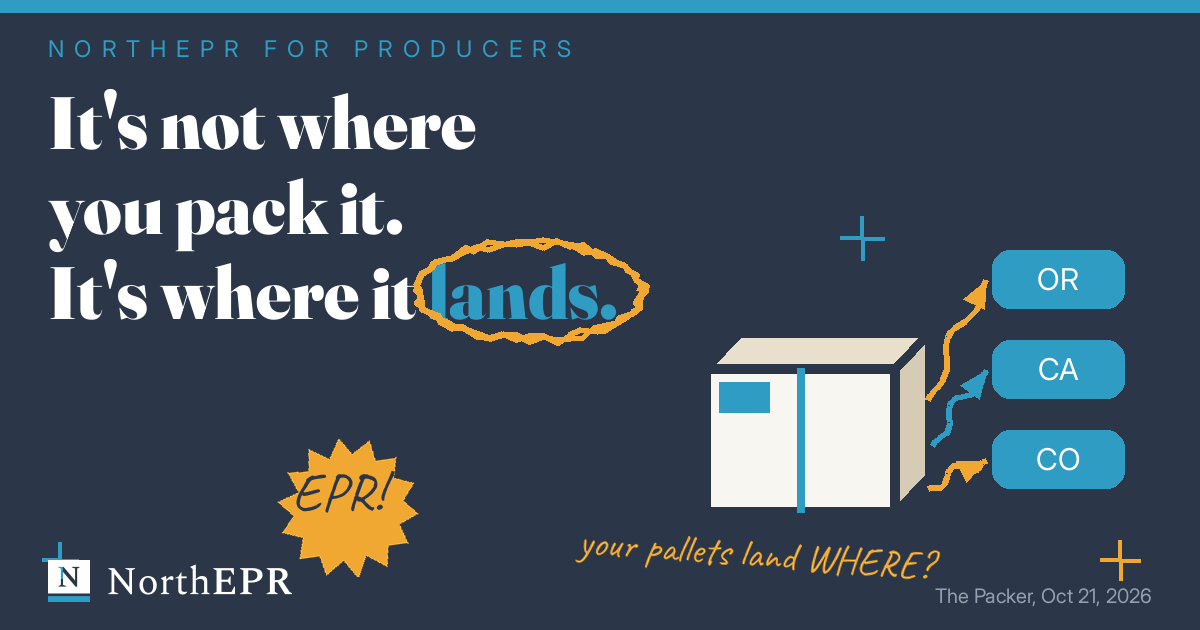
- Under packaging EPR laws, your obligation is triggered by where your packaged goods end up, not where they were packed or shipped from.
- A produce shipper in a non-EPR state can still be on the hook in California, Oregon, Colorado, Minnesota, Ontario, and every other destination with an active program.
- The October 1 California plastics reporting deadline already passed, and some companies only started asking for their data after it was due.
- Mapping every state and province you sell into is the whole compliance picture, and it is worth doing before the fee invoices arrive.
If you pack your product in one state and ship it into another, where does your packaging compliance obligation live? According to Victoria Lopez, marketing and business development manager for Fox Packaging, who spoke at the International Fresh Produce Association (IFPA) Global Produce and Floral Show in Orlando, Florida, the answer trips up a lot of shippers: state EPR compliance liabilities "are triggered by where packaged goods land, not where they are packed".
"But where are your bags going?"
Lopez described a customer in the Northeast who told her they were not concerned about EPR because EPR laws are not in place in their state. The problem: the customer's shipments into EPR-active states still create obligations. Her warning: "But where are your bags going? You need to think of the destination. If your destination is in the states in which this is active, then you qualify to be fined." (The Packer, Oct 21, 2026)
This is the mental model shift. Most producers think about compliance as something that happens at home, where they are headquartered or where the line runs. Packaging EPR works the other way: the obligation follows the product to the shelf. Pack in Texas and sell into California and Oregon, or produce in the Maritimes and ship into Ontario, and you can be obligated in every destination jurisdiction with an active program, even if your home state or province has no EPR law at all.
The October 1 deadline that already passed
The trap is not theoretical. Lopez said some California produce companies came to her asking for plastics-use data after the deadline had already gone by. Her response: "And I go, 'That was due Oct. 1.'" (The Packer, Oct 21, 2026)
Companies scrambling for basic material data after the reporting date shows how easy it is to assume the obligation sits somewhere else. It does not. If your product lands in California, California's timeline applies to you.
The fees are smaller than the fear, but the details are not
One of the more useful things Lopez shared is that the actual fees are often modest. "If you look at the calculator, some people are only going to pay $300, maybe $700. So, some of it is significant, and some of it is not." (The Packer, Oct 21, 2026)
That cuts both ways. A few hundred dollars in fees is no reason to panic. And as Lopez points out, the material data you need may already be sitting with your packaging supplier: "I give them everything for free." (The Packer, Oct 21, 2026)
The expensive part is getting the details wrong. Fox Packaging itself paid roughly $40,000 for a test to clear its mesh recyclable bag in one state, then was fined because the lab was not an approved APR (Association of Plastic Recyclers) lab. The rules are specific, they vary by jurisdiction, and guessing is the costly option.
What the "where you sell" map looks like in practice
For a food or beverage producer selling across North America, the destination map gets long fast: California, Oregon, Colorado, Minnesota, and Washington all have packaging EPR programs at various stages in the US, and in Canada, Ontario, British Columbia, Quebec, Nova Scotia, New Brunswick, Alberta, Saskatchewan, Manitoba, and Yukon all run producer-responsibility programs, plus the Federal Plastics Registry. Each has its own registration, reporting format, material definitions, and fee schedule. None of them care where you packed the product.
That is the whole compliance picture: one obligation per destination, multiplied by everywhere your product lands. The producers who handle this well do three things: list every state and province they sell into (not just where they are based), pull their packaging material data once in a reusable format, and check each destination's deadlines and fee calculators before the invoices arrive.
One view of everywhere you sell
This is exactly the problem NorthEPR is built for. Instead of tracking a dozen programs in spreadsheets, you get one view of every jurisdiction you sell into, estimated fees before the bill arrives, and draft reports ready for each program's portal. The destination-state trap disappears when you can see the whole map at once.
If you want to see what your destination map looks like, we run a free packaging data health check for food and beverage producers: northepr.com/pilot. Load a sample of your real catalogue, and we run it against the current rules so you can see your estimated obligations everywhere you sell. No contract, no commitment.
Sources
- The Packer, "Produce Shippers' Make Potentially Costly Oversight on Packaging Destination," by Christina Herrick, Oct 21, 2026: https://www.thepacker.com/news/produce-shippers-make-potentially-costly-oversight-packaging-destination
NorthEPR prepares the filing; the producer files in each program's portal and pays fees directly. This post is general information, not legal, tax, or accounting advice.