Recycled Content Rules for Packaging EPR: What Producers Must Hit and Report
V. Jain · · 5 min read
Recycled Content Rules for Packaging EPR: What Producers Must Hit and Report
In short
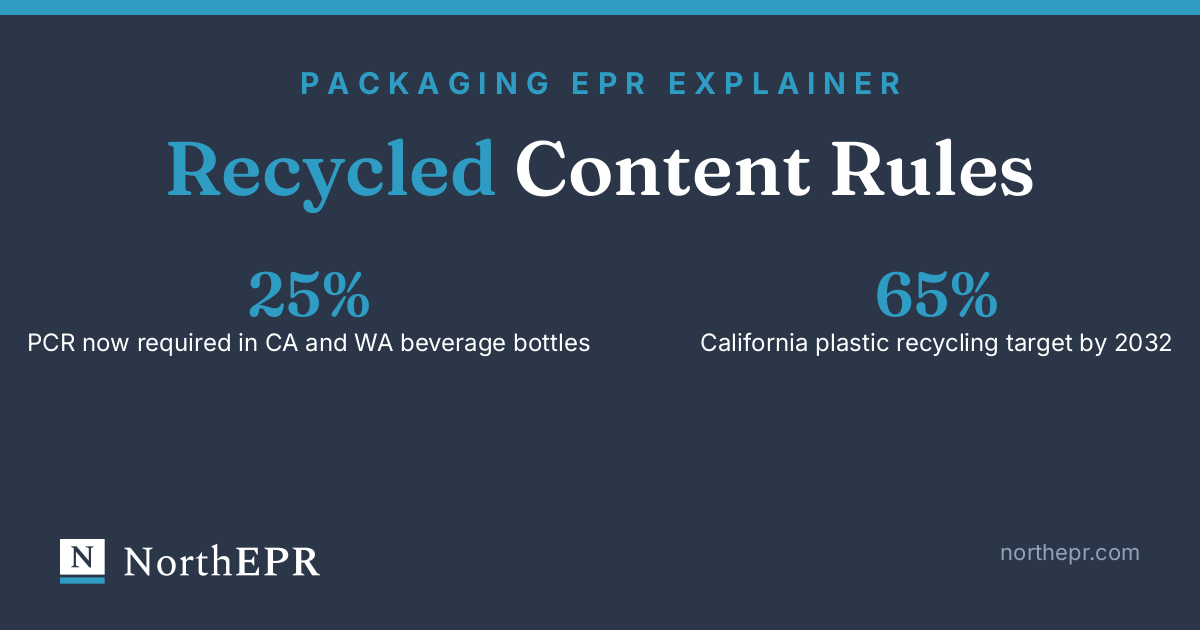
Recycled content has moved from a sustainability talking point to a compliance number. In California, plastic beverage bottles must already average 25% post-consumer recycled (PCR) plastic, and Washington's beverage bottle rule steps up to 25% on January 1, 2026. SB 54 separately sets program-wide targets: 65% of single-use plastic packaging recycled by 2032 and a 25% cut versus 2023.
What "recycled content" means in the rules
Recycled content is the share of a package, by weight, made from recycled material rather than virgin resin. Post-consumer recycled (PCR) content comes from material that was used by a consumer and then collected for recycling. Post-industrial content comes from manufacturing scrap that never reached a consumer. The laws below are written around PCR, so factory scrap does not count toward a PCR target.
Targets are measured as averages across a producer's sales in a state, not bottle by bottle. That is why reporting is done in pounds and kilograms per resin type, and why your data has to be at SKU level.
California: two laws, two clocks
California runs two separate recycled content regimes at once. The first is AB 793, the beverage bottle law. Plastic beverage containers covered by the state's California Redemption Value program must average at least 15% PCR from January 1, 2022, 25% from January 1, 2025, and 50% from January 1, 2030. Manufacturers that miss the target pay a penalty of 20 cents for each pound of PCR they fall short by. CalRecycle, Plastic Minimum Content Standards and Reporting (AB 793)
The second is SB 54, the packaging EPR law. By January 1, 2032, all single-use packaging and plastic food service ware sold in California must be recyclable or eligible to be labeled compostable, 65% of single-use plastic packaging must actually be recycled, and single-use plastic packaging must be cut by 25% against a 2023 baseline. The recycling rate has interim steps: 30% by 2028 and 40% by 2030. CalRecycle, SB 54 Covered Material Category List, January 2026 update
SB 54 sets no per-bottle PCR percentage. It sets system-wide outcomes, and the data producers report shows whether they are met. Fees under the program are eco-modulated, so the fee a producer pays reflects the material and recyclability of its packaging. Our California SB 54 guide covers the fee side.
Washington: the 25% step lands January 1, 2026
Washington's SB 5022 (2021) sets minimum PCR content for plastic beverage containers, trash bags, and household cleaning and personal care product containers. For beverage containers other than dairy milk and 187 ml wine bottles, the minimum is 15% for 2023 through 2025, 25% for 2026 through 2030, and 50% from 2031. Dairy milk and 187 ml wine containers join later: 15% from 2028, 25% from 2031, and 50% from 2036. Washington State Legislature, SB 5022 bill report
The practical point: if you sell bottled drinks in Washington, your 2026 bottles need to average 25% PCR. That is a packaging specification decision to agree with your bottle supplier now, not a paperwork exercise for year end. Washington also runs a separate EPR program for packaging, so the same SKU data feeds two obligations. Our Washington producer guide covers the EPR side.
Oregon: an old rule, and fees that reward recycled content
Oregon has had a recycled content rule on the books since 1991. Under ORS 459A.655, a rigid plastic container sold in Oregon must meet one of three tests: contain 25% recycled content, be made of plastic recycled in Oregon at a rate of 25%, or be reused five or more times. In practice, Oregon has certified the aggregate recycling rate above 25%, so most containers comply through that test rather than the content test. ORS 459A.655
Oregon's newer law, the Recycling Modernization Act, sets no new PCR percentage. Instead it requires the producer responsibility organization to build a graduated fee structure that factors in a producer's use of post-consumer recycled content, along with recyclability and product-to-package ratio. Recycled content lowers your Oregon fees even though no fixed percentage is mandated. Oregon DEQ, Recycling Modernization Act FAQ
Canada: report it, even where no minimum exists
No Canadian province sets a hard minimum recycled-content percentage for packaging today. Canada's approach is reporting first. Under the Federal Plastics Registry, companies that place plastic packaging on the Canadian market must report the resin source for what they sell: virgin, post-industrial recycled, or post-consumer recycled, as separate categories. The registry sets no recycled-content target, but it makes the number visible to the regulator, and a single combined recycled figure does not fill the form. Phase 1 reporting continues, with the deadline for 2025 data on September 29, 2026. Federal Plastics Registry reporting guide
What to do with this now
First, know your number. For every plastic SKU you sell into California, Washington, or Oregon, get the PCR percentage by weight, per component, from your packaging supplier. Ask for PCR and post-industrial separately: one combined recycled figure is not enough for the forms. Our post on getting packaging data from suppliers has template language you can use.
Second, check the 2026 step-ups. If you sell bottled drinks in Washington, the 25% tier starts January 1, 2026. If you sell CRV bottles in California, you are already in the 25% tier. Confirm with your bottle supplier that the resin you are buying meets the average, and keep the documentation.
Third, keep the records. Oregon requires compliance records kept for audit for at least three years; the Federal Plastics Registry requires reported information and its calculations kept for three years from the due date. Treat this evidence like EPR filing evidence: filed, dated, and retrievable.
These rules will keep tightening, on fixed dates where mandates exist and through fees where they do not. The producers who struggle will be the ones who cannot say, per SKU, what their packaging is made of.
Try the free pilot
Our free pilot runs a health check on your 2026 packaging data and walks through your first filing. Start at northepr.com/pilot.
Sources
- CalRecycle, SB 54 Covered Material Category List, January 2026 update
- CalRecycle, Plastic Minimum Content Standards and Reporting (AB 793)
- California AB 793 bill text
- Washington State Legislature, SB 5022 bill report
- ORS 459A.655, minimum reuse, recycled material or recycled content for rigid plastic containers
- Oregon DEQ, Recycling Modernization Act FAQ
- Federal Plastics Registry reporting guide
This is general information, not advice about your company. Confirm deadlines, fees, and obligations with each program or PRO before acting.