Maine Packaging EPR: First Law in the US, Still No Operator
V. Jain · · 5 min read
Maine Packaging EPR: First Law in the US, Still No Operator
In short
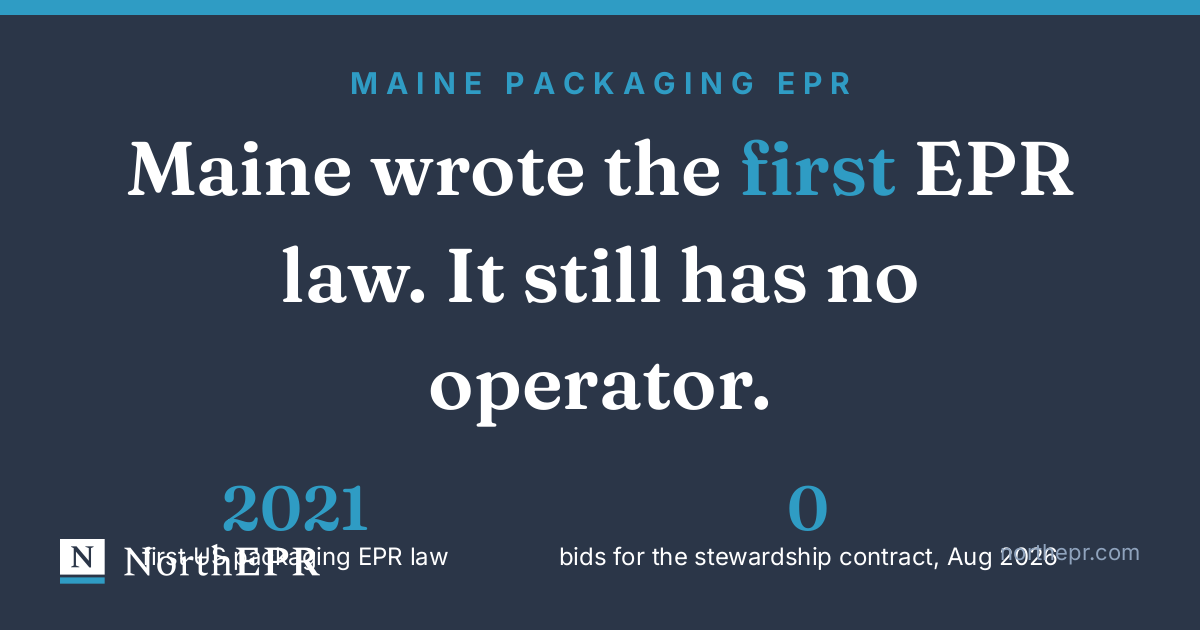
Maine passed America's first packaging EPR law in July 2021, but five years on the program still has no operator: the state's request for a stewardship organization drew zero bids in August 2026, and the Maine Department of Environmental Protection (DEP) is revising the request and reassessing the schedule. If you sell packaged food or beverages into Maine, there is nothing to register for yet. But the law, the exemptions, and the fee design are already set, including a perishable food exemption worth knowing.
The first mover, stuck at step four
Maine's Stewardship Program for Packaging, LD 1541, was enacted in July 2021 and codified at 38 M.R.S. section 2146. Maine DEP program page It made Maine the first state with a packaging EPR law, a year before Colorado and California followed in 2022. 38 M.R.S. section 2146
Chapter 428, the implementing rule, was adopted in December 2024 and amended in March 2026 to align with LD 1423, signed in June 2025. LD 1423, P.L. 2025, ch. 383
Then the program hit the step that matters most. DEP breaks implementation into nine steps, and the program is sitting at step four, "Contracting with an SO." The SO is Maine's name for the PRO, which would run registration, collect fees, and pay municipalities. DEP published its request for proposals on June 15, 2026. It closed on August 18 with zero proposals, and Circular Action Alliance, the PRO that runs the programs in the other six EPR states, announced it would not bid. rePurpose Global, Aug 20, 2026
DEP said on September 11, 2026 that it would revise and reissue the RFP, and on October 28 it sent a revised version to the Office of State Procurement for review. EPR Atlas Until a contract is signed, every deadline in the program is on hold. DEP says it is reassessing the schedule and will post a revised one on its program page. Maine DEP program page The earlier dates, registration in 2026 and first invoices in 2027, no longer apply.
Who counts as a producer in Maine
As in our Oregon and California guides, the brand owner is first in line: for products sold at physical retail, the producer is the manufacturer selling under its own brand. The sole importer of a foreign-produced packaged product is the producer when the brand owner has no US presence. Franchisors count; local franchisees do not. Nonprofits under section 501(c)(3) are not producers. 38 M.R.S. section 2146
Responsibility can also be assigned to another person by signed agreement. That matters for private label arrangements, where the contract decides who files. See our private label guide.
The exemptions food producers should know
Maine's exemption list is the most generous of any US state, written with food in mind. A producer is exempt in any calendar year where any one of these applies: 38 M.R.S. section 2146
- Under $2,000,000 in total gross revenue in the prior calendar year, rising to $5,000,000 for the period one to three years after the SO contract takes effect.
- Less than one ton of packaging sold into Maine in the prior calendar year.
- More than 50 percent of total gross revenue from goods acquired through insurance salvages, closeouts, bankruptcies, or liquidations.
- Perishable food sold into Maine in less than 15 tons of packaging: bakery products, fresh and processed meats, poultry, seafood, dairy, shell eggs, and fresh fruits and vegetables. Frozen food is excluded, except frozen wild blueberries.
Producers between one and 15 tons get simplified reporting and a flat fee of $500 per ton. EPR Atlas, de minimis thresholds
How the fees will work
The fee design is set, though no fees are being collected yet: material type fees track the average per-ton cost of recycling, reusing, or composting each type, and packaging that is not readily recyclable costs twice as much. From the third year, producers also pay incentive fees if the program misses its targets. Resource Recycling, Dec 17, 2024
Start-up fees must also cover one year of the SO's operating costs plus a $30,000 state administrative fee, and beverage containers under the bottle bill are not counted as packaging material. Verrill, Dec 26, 2024
The annual cycle, once the program runs
Once an SO is under contract, the rhythm is fixed: report by May 31, invoiced by July 1, pay by September 1, municipal reimbursements by October 1. Registration comes first, within 90 days of the SO opening registration, and sales of products in noncompliant packaging are banned one year after the contract takes effect. Maine DEP program page rePurpose Global, Aug 20, 2026
What to do now
Nothing is due today, and that is exactly the trap. The producers who will be ready are the ones who use the pause.
- Check whether you are the producer, starting with the brand owner test.
- Work out your Maine tonnage and test it against the exemption lines, especially the perishable food allowance.
- Build SKU-level packaging data now; our guides on getting packaging data from suppliers and weighing packaging for your first report cover the practical steps.
- Ask DEP to add you to its updates list at MainePackagingEPR@maine.gov, and watch for the reissued RFP: the day an SO is selected, the 90-day clock starts. Maine DEP program page
The bottom line
Maine wrote the first packaging EPR law in America, then spent five years getting it ready. The zero-bid RFP is a setback, not a repeal: the law, the rule, the exemptions, and the fee design are all in place, so treat this as a head start, not a reason to wait.
We built NorthEPR to help food and beverage producers sort out exactly this: which SKUs you report, in which jurisdictions, and with what data. We are opening 3 free pilot spots right now: a 2026 packaging-data health check plus first filing support. Take a look at the pilot.
Sources
- Maine DEP, Extended Producer Responsibility for Packaging
- 38 M.R.S. section 2146, Stewardship program for packaging
- LD 1423, An Act to Improve Recycling by Updating the Stewardship Program for Packaging (P.L. 2025, ch. 383)
- rePurpose Global, Zero Bids for Stewardship Organization, Including CAA: Maine EPR Faces Timeline Delay, Aug 20, 2026
- EPR Atlas, EPR Reporting Deadlines by State
- EPR Atlas, EPR De Minimis Thresholds by State
- Resource Recycling, Maine board approves EPR rules, Dec 17, 2024
- Verrill, Unwrapping Maine's Gift to the Environment, Dec 26, 2024
This is general information, not advice about your company. Confirm deadlines, fees, and obligations with each program or PRO before acting.