E-Commerce EPR: What Direct-to-Consumer Brands Owe When They Ship
V. Jain · · 5 min read
E-Commerce EPR: What Direct-to-Consumer Brands Owe When They Ship
In short: If you sell packaged goods online, your EPR obligations follow the delivery address, not your warehouse. In British Columbia, Ontario, Quebec, California and Oregon, an online seller can be the obligated producer with no store, office or warehouse in the jurisdiction. The box you ship in usually counts as packaging you supplied, and marketplace sales can put the duty on a different party than your own-store sales. Check each destination against its own producer definition first.
The delivery address decides, not your warehouse
EPR laws attach to the place where the packaged product lands with the consumer. If your online store ships a jar of jam from Fredericton to a customer in Vancouver, the BC rules look at that Vancouver delivery. If the same order goes to Portland, the Oregon rules look at that delivery. Your business address matters far less than the addresses on your shipping labels.
That is the first thing most direct-to-consumer brands get wrong. They check whether they have a presence in a province or state, and stop there. Presence is only one part of the test. The producer definition is what decides it, and the definitions have been written to catch online sales on purpose.
Who is the producer when the sale happens online?
Every program has its own producer ladder, and it usually starts with the brand owner. If you own the brand and sell it in, the duty is usually yours. Our guide to who files the report for private label products walks through how that ladder works when someone else makes your product.
British Columbia made this explicit on October 27, 2025, when amendments to the Recycling Regulation expanded the definition of producer to include sales made online, by phone, or by mail. Importers who bring products into BC are also defined as producers. Product Care's summary of the amendments BC's own producer guide says you are a producer if you sell or distribute products with packaging in BC. BC government producer guide
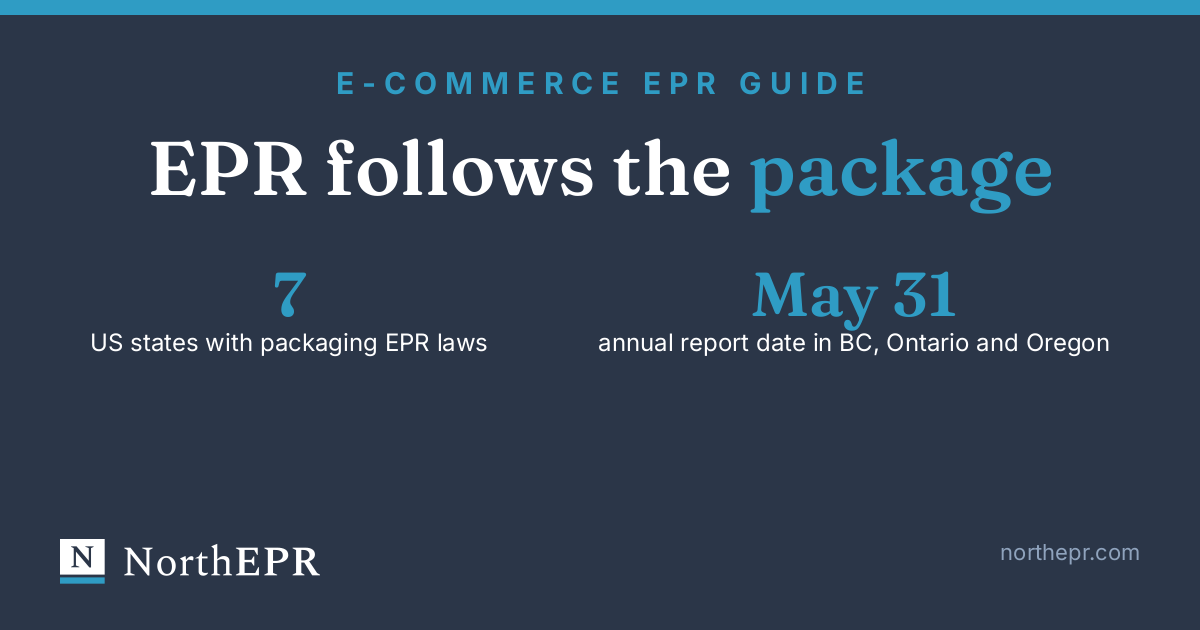
Ontario's Blue Box rules take a different split. If you sell your own brand on your own site, you are the producer. But if you sell through a marketplace, the marketplace facilitator can be the obligated producer for your Blue Box material. RPRA Blue Box producers page Your marketplace sales and your own-store sales can land on different parties, so know which channel each order came through before you report. New producers must register with RPRA within 30 days of first supplying Blue Box material, and the annual supply report is due May 31.
Quebec's rules go further toward the platform. The operator of a transactional website carries the producer obligation for targeted products sold to Quebec individuals, even when the purchase happens from outside Quebec. Strategic Packaging Insights on marketplace obligations
California's SB 54 uses a broad producer definition that reaches brand owners, licensees, and, if those are not in California, sellers or distributors placing products into the state. Out-of-state and e-commerce sellers can be in scope when products are delivered to California buyers. Legal 500 on SB 54 The statute text defines covered material to include packaging used to contain, protect, handle, deliver or present goods. Producers had to join Circular Action Alliance, register with CalRecycle, or apply for the small producer exemption by June 1, 2026, with the program targeted to start on or before January 1, 2027.
Oregon, the first US state with an operating packaging EPR program, uses the same brand owner ladder, and producers report prior-year supply data to Circular Action Alliance by May 31 each year. Our Oregon producer guide Maryland required PRO registration by May 31, 2026 and Washington by July 1, 2026, so sellers shipping into those states should already be registered. White and Case on US EPR laws
The shipping box counts too
This is the second thing direct-to-consumer brands miss. The mailer box, the poly mailer, the tape and the void fill are packaging you supplied to the consumer, and in most programs they belong in your report alongside the product packaging. Oregon writes this into the statute: the person that packs and ships a remote or internet sale is the producer of the shipping packaging. Strategic Packaging Insights on producer definitions
Small sellers are not all exempt
Every program has a small producer line, and the lines are not the same. BC exempts producers under $1 million in BC revenue, or under one tonne of packaging supplied to BC residents, and a single point of retail does not count if you sell online. BC government producer guide California's small producer line sits at $1 million of gross annual sales, while Oregon and Colorado set theirs at $5 million of revenue. Strategic Packaging Insights on producer definitions A brand that is exempt in Oregon can still be obligated in BC, so check each program separately. Our guide to small producer exemptions compares the tests across programs.
What to do before your next shipment
- List every province and state you shipped to last year, from your order data, not from memory.
- For each one, work out who the producer is for your own-store sales and your marketplace sales separately.
- Separate your packaging data into product packaging and shipping packaging, by material and weight.
- Register where you are obligated, and put May 31 on your calendar: BC, Ontario and Oregon all use it for the annual report.
- Keep the evidence: supplier spec sheets, scale weights, and the order records that show where each package went. That is what an audit asks for. Our guide to audit-ready packaging data
We built NorthEPR to help food and beverage producers get this ready: packaging data at SKU level and filings prepared across Canada and the US. We are opening 3 free pilot spots: a 2026 packaging-data health check plus first filing support. Take a look at the pilot.
Sources
- Product Care, Amendments to BC's Recycling Regulation and expansion of obligated products categories, Nov 6, 2025
- Government of British Columbia, Taking Responsibility for your Packaging and Paper Products, Nov 2025
- RPRA, Blue Box Producers
- Strategic Packaging Insights, EPR Online Marketplace Obligations
- Legal 500, SB 54 Is In Effect: What California's New Packaging Law Means For Your Business
- SB 54 statutory text, California Public Resources Code
- Strategic Packaging Insights, EPR Producer Definition: EU, UK, US States and India
- White and Case, Extended Producer Responsibility (EPR) laws: A new supply chain compliance requirement, June 25, 2026
This is general information, not advice about your company. Confirm deadlines, fees, and obligations with each program or PRO before acting.