EPR Audit-Ready Packaging Data: How Software Helps
V. Jain · · 5 min read
EPR Audit-Ready Packaging Data: How Software Helps
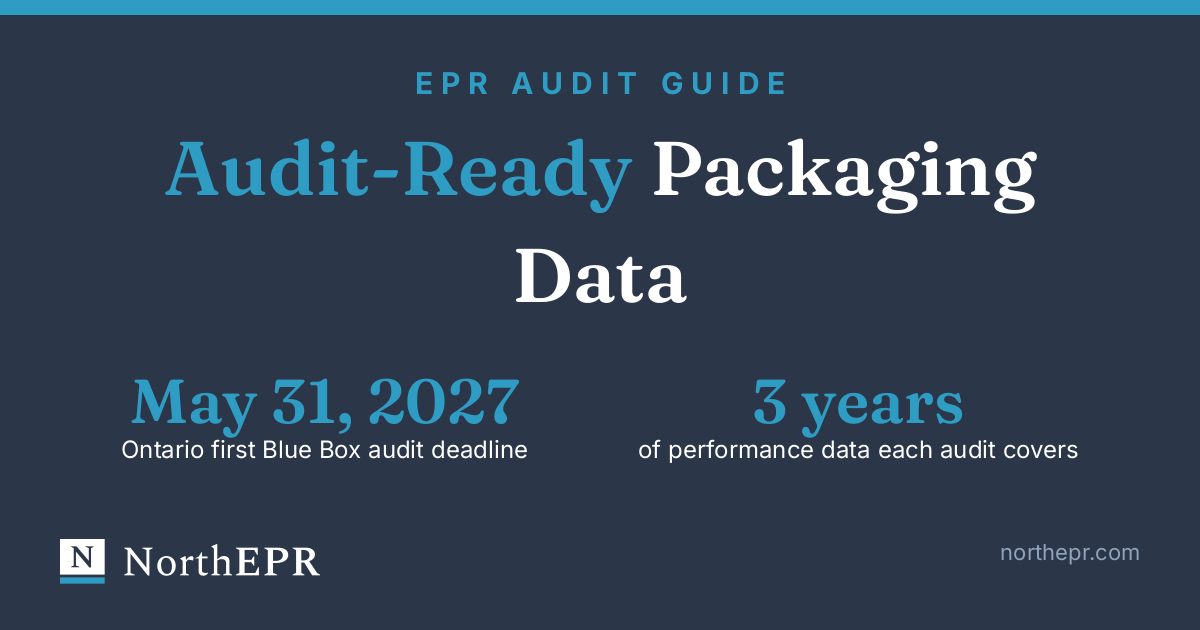
In short: Ontario Blue Box producers face their first performance audit by May 31, 2027, covering reported data from 2024, 2025, and 2026. The auditor checks whether your reporting methodology is reasonable and whether supporting evidence backs your numbers. Audit-ready data means SKU-level weights, a documented method, and records you can still find when asked. Software helps by keeping that evidence in one versioned place instead of across scattered spreadsheets.
Ontario made the audit real, with a date
Ontario changed that. Under section 67 of Ontario's Blue Box Regulation, producers must have an audit of their practices and procedures undertaken on or before May 31, 2027, and every third year after that, covering the three immediately preceding calendar years. The Resource Productivity and Recovery Authority (RPRA) confirms the same timeline on its Blue Box producers page: starting in 2027, and every three years thereafter, producers or their PROs must submit an audit verifying performance reporting, with the first audit covering 2024, 2025, and 2026.
That date matters for a practical reason. If your 2024 and 2025 reports were built on estimates or a spreadsheet someone has since overwritten, you cannot rebuild that evidence retroactively with confidence. The audit does not ask whether your numbers look plausible. It asks whether you can show your work.
What an auditor actually asks for
Ontario's Blue Box Verification and Audit Procedure sets out what the verifier does: assess and document the reasonableness of the producer's methodology for determining Blue Box material supply, and obtain and review supporting evidence as required. The auditor wants two things.
First, a methodology. How did you decide what counts as supplied packaging, how did you weigh it, and how did you allocate transport packaging? A method written down once and applied the same way every year is defensible. A method reinvented each reporting cycle is not.
Second, evidence. Weight records, supplier specifications, sales data by jurisdiction, and the fee schedule version you reported against. RPRA's draft reporting procedure goes further: from 2028, producers will have to report the method used to validate weights and meet minimum percentages of gross weight validated by data integrity tier. That is still draft procedure under consultation, not a final rule, but it shows the direction of travel: validated weights, not asserted ones.
Oregon points the same way. Under the Recycling Modernization Act, producers must register with an approved producer responsibility organization, report data on their supply of covered products into the state, and pay membership fees to the PRO.
The five records that make a file audit-ready
Whether you report in Ontario, Oregon, or both, an audit-ready file has the same five pieces:
-
A SKU list tied to sales by jurisdiction. Every SKU sold into the reporting jurisdiction during the reporting year, with units sold. If you cannot say how many units went to Ontario versus Quebec, neither report is defensible. Our guide on how to weigh packaging for your first EPR report walks through building this list.
-
Component-level weights with a stated method. Each packaging component weighed or estimated by material, with the method recorded: scale-weighed samples, supplier specs, or a documented estimation approach. Keep the method consistent year to year.
-
Material mapping to the program's categories. Your components mapped to the specific material list of the program you reported to. Programs differ in the details, so a mapping done for one program is not automatically valid for another.
-
The fee schedule version you used. Fee schedules change. Keep the version your report was calculated against, so a later revision does not make your filed numbers unexplainable. Our guide on how to read an EPR fee schedule covers what to watch for in these documents.
-
A reconciliation. Total reported packaging weight checked against purchasing records, adjusted for inventory change. A gap between what you bought and what you reported is the first thing an auditor notices, and it is much cheaper to find it yourself.
Where spreadsheets break under audit
Most producers keep it in spreadsheets, and spreadsheets fail audits in predictable ways. Someone overwrites last year's tab to build this year's report, and the filed version is gone. Two people keep two copies, and nobody knows which one was submitted. A formula changes silently. A supplier spec sheet gets updated mid-year and the old weight disappears without a trace. An auditor does not need to find fraud to find a problem. A missing version or a number nobody can trace back to a scale or a spec sheet is enough to turn a routine verification into a long, expensive exercise.
How software changes the audit conversation
Software does not make an audit go away, and no tool can certify your numbers for you. What it does is keep the evidence chain intact by default. One SKU list, one set of component weights, one material mapping, versioned so that last year's filed report can be reproduced exactly. When a fee schedule updates, the new version applies going forward while the old calculation stays on record. When a supplier changes a spec, the change is dated, not silently overwritten. That versioning is the difference between answering an auditor in an afternoon and spending weeks reconstructing three years of data from email attachments.
The producers who will sleep best through the May 2027 audit window are not the ones with the cleverest methodology. They are the ones whose methodology is written down, whose weights are traceable, and whose filed reports can be reproduced. Build that file now, while 2024 and 2025 are still recent enough to document properly.
We built NorthEPR for exactly this problem: software that helps food and beverage producers figure out where they have to report their packaging, what they owe, and get their filings ready on time, across Canada and the US. We are opening 3 free pilot spots right now: a 2026 packaging-data health check plus first filing support. Take a look at the pilot.
Sources
- O. Reg. 391/21, Blue Box Regulation, section 67 (audit requirement)
- RPRA Blue Box producers page (performance audit reporting from 2027)
- Ontario Blue Box Verification and Audit Procedure (verifier duties)
- Oregon DEQ, Producers of Covered Products (registration, reporting, and fees)
This is general information, not advice about your company. Confirm deadlines, fees, and obligations with each program or PRO before acting.