How to Correct an EPR Report After You File It
V. Jain · · 5 min read
How to Correct an EPR Report After You File It
In short: A wrong EPR report is fixable, but every program has its own route and clock. Quebec gives you a formal revision form and a one year window. Ontario producers email RPRA with evidence. BC reports go back through National Steward Services. In Oregon, your first call is CAA. Fix it as soon as you spot it, and keep the working papers that prove the corrected numbers.
You filed the report, then operations mentions the new pouch weighs 4 grams more than the old one, or finance finds a SKU that was never on the list. No major program treats a filed report as final, but the fix is never just editing a cell in a portal.
Why a correction is worth doing
EPR fees are weight based, so a weight error flows straight to the bill. Our guide on how to read an EPR fee schedule shows how rates times weights become your invoice. Over reporting means money paid for packaging you never sold; under reporting is a liability that can surface in an audit.
There is a compliance reason too. In Ontario, submitting false or misleading information to RPRA is an offence under the Resource Recovery and Circular Economy Act, and RPRA's guidance says it wants errors corrected as quickly as possible.
Quebec: the most formal process
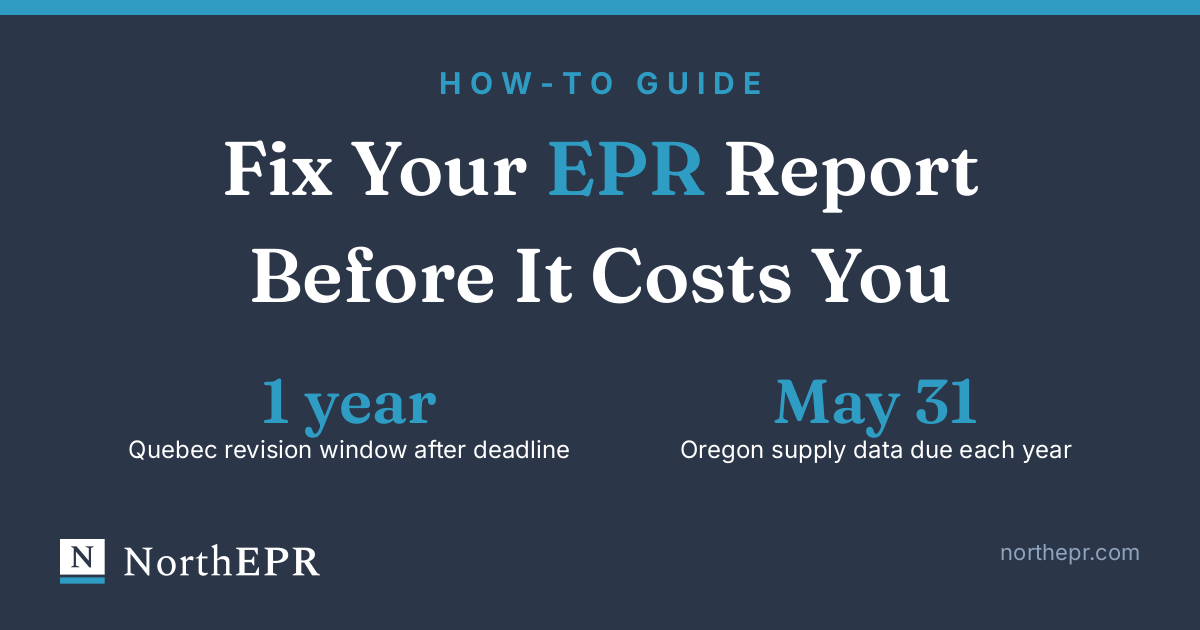
Quebec has the clearest correction route we track. Éco Entreprises Québec (ÉEQ) publishes a Material report revision request form for revising a report already submitted. It must be signed by the company's designated primary contact, and it must reach ÉEQ no later than one year after the reporting deadline for the obligation year. For double reporting, where two parties reported the same material, the window is two years.
You must attach the original detailed working documents in Excel, plus the revised versions, a summary of the requested changes for each material, and any studies or calculations behind your assumptions, exclusions, or deductions. Include every change at once, because any subsequent filing can trigger administrative fees.
Ontario: email RPRA, with evidence
Ontario's route runs through the regulator, not the PRO. RPRA's guidance says that to adjust performance data reported to RPRA, you must contact the Compliance and Registry Team immediately by emailing registry@rpra.ca, with the rationale for the change, data that supports it, such as a tonnage purchase or sale contract or an audit, and any other supporting information. RPRA only accepts the request from the primary contact on the company's Registry account.
RPRA also stopped accepting extension requests for registration or reporting deadlines in February 2023, so a correction is not a way to buy time on a missed deadline. The full process is on RPRA's adjustment guidance page.
British Columbia: go back through the portal team
Recycle BC and the other Circular Materials programs run on the WeRecycle Portal. The published answer to "can you update a report already submitted" is yes, contact National Steward Services to assist. Depending on the reporting period, you may be able to update the report directly, or you may need a steward initiated adjustment, per Circular Materials' own reporting webinar Q and A. Confirm the current process with National Steward Services before you act.
Oregon and the US states: start with CAA
Oregon's program runs through the Circular Action Alliance, the state's only approved producer responsibility organization. Oregon DEQ's producer page states that CAA is the first point of contact for reporting guidance, and inquiries go to its Producer Services Team at Producer.Support@circularaction.org.
Timing matters. Oregon's first supply report, covering 2024 data, was due March 31, 2025, and from May 31, 2026, supply data for the prior year is due to CAA on or before May 31 of each year. If your correction changes a material weight, it changes the fee base for that program year, so raise it before the next fee cycle rather than after the invoice lands. Our Oregon producer guide has the full timeline.
What to send with any correction
Whatever the program, the package that gets approved fastest has the same shape: the original and revised numbers side by side at SKU and component level, not as a single adjusted total; the reason for the change in one or two sentences; the evidence, meaning the corrected working spreadsheet, supplier confirmations, weigh tickets, or audit findings; and the impact on fees, stated plainly, whether the correction raises or lowers what you owe. Programs recalculate either way. Keep a copy of everything you send and the program's written decision.
How to stop needing corrections
Most corrections trace back to the same few root causes: reporting from spec sheet weights instead of weighing samples, which our guide on how to weigh packaging for your first EPR report covers step by step; a SKU list that missed a product line; and no reconciliation of total reported weight against packaging purchased during the year. Build the reconciliation in, file early enough to re-check the numbers, and the corrections mostly disappear.
The bottom line
A wrong EPR report is not a disaster. It is a normal part of first filings, and every program has a way to fix it. Quebec wants a signed form within a year, Ontario wants an email to RPRA with evidence, BC goes through National Steward Services, and Oregon starts with CAA. Corrections are faster, cheaper, and less painful when you raise them yourself, with the working papers in hand, before an audit raises them for you.
We built NorthEPR to make this whole cycle less painful: software that shows food and beverage producers where they have to report, what they owe, and gets their filings ready on time across Canada and the US. We are opening 3 free pilot spots for a 2026 packaging data health check plus first filing support. Take a look at the pilot.
This is general information, not advice about your company. Confirm deadlines, fees, and obligations with each program or PRO before acting.
Sources
- Éco Entreprises Québec, Material report revision request form: https://www.eeq.ca/assets/Tarif-et-Consultation/Volet-declaration/2023_form_modification_vfa_en.pdf
- RPRA, What do I do if I need to adjust my performance data: https://rpra.ca/audience/retreader/
- Circular Materials, February 26, 2019 Reporting Webinar Q and A: https://www.circularmaterials.ca/wp-content/uploads/2023/07/R2R-Reporting-Webinar-QA_Feb-26-2019_Final.pdf
- Oregon DEQ, Producers of Covered Products: https://www.Oregon.gov/deq/recycling/Pages/Producers-of-Covered-Products.aspx